

Logan's Story
‘Nothing Short Of a Miracle’
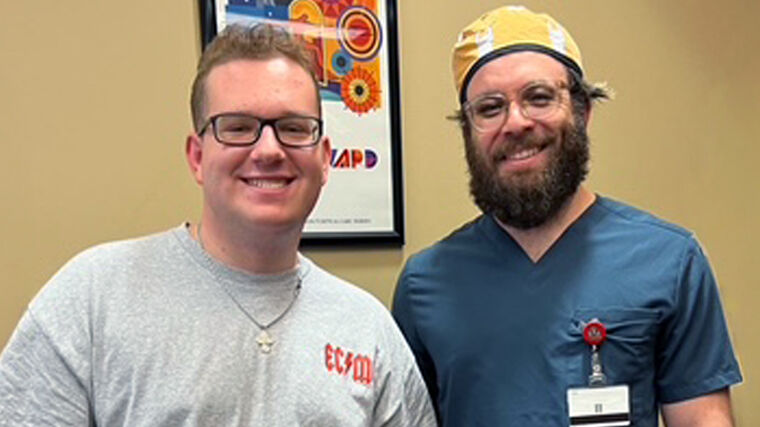
On July 17, 2024, for the second time in two days, Logan Sheehan was in the emergency department of Dayton Children’s Hospital. Recently turned 18, he thought to himself: “I just graduated high school, man. I'm invincible.” The way nurses and doctors scrambled with laser focus around him indicated otherwise. “It was just, like, pure chaos, you know?” he remembers.
Two days earlier his mother, Kim Sheehan, took him to the doctor. He was feeling lethargic. “Out of character,” Kim says. “He couldn't sit up at the doctor's office. He had a high fever, he was super, super weak.”
From there, he went to the Children’s Hospital emergency department, for the first time. Logan, usually talkative, was not speaking. In fact, his caregivers asked her and Logan’s father, Joe, if he was nonverbal. Logan can now set the record straight: “I will talk your head off.”
In the ER, Logan was diagnosed with pneumonia in his left lung. Antibiotics helped revive him. He was discharged to rest and recover at home.
Dropping Oxygen Level
Two days later, he says, “I vaguely remember falling in the shower.” After that, his oxygen saturation level, which they were monitoring at home with a pulse oximeter, was 84 percent. (Normal range for healthy adults is 95 to 100 percent. Low oxygen saturation, hypoxemia, is below 90 percent and calls for medical attention. Levels at or below 88 percent are a medical emergency.)
Logan’s breathing was not labored, but his mother knew it was time to rush back to the ER. (Oxygen saturation is the percentage of life-sustaining, oxygen-carrying hemoglobin in the blood, a key indicator of respiratory and circulatory function.)
In the ER he was told he had septic shock, a serious reaction to an infection, like pneumonia, which can damage tissue and organs.
The same ER doctor who saw Logan on his first visit informed him that the pneumonia was now in both lungs. During this visit, his mother says, “He was in and out, like his eyes were rolling back in his head. It was horrifying.”
The Sheehans’ priest administered last rites to Logan before he was moved to the ICU. In the ICU he got chest x-rays to monitor the progression of the pneumonia, which filled more and more of his lungs.
“He was just in and out, too weak to get out of bed, too weak to sit up, too weak to roll over on his own,” Kim says. To help him breathe, Logan was put on a BiPAP (bilevel positive airway pressure) machine, a noninvasive ventilator used to treat breathing difficulties and improve blood oxygen levels.
But the pneumonia continued filling his lungs, so he was intubated – a breathing tube placed in his trachea, or windpipe, to allow a mechanical ventilator to breathe for him. But his oxygen saturation continued to fall. When it dropped into the 50s, his caregivers began administering chest compressions to help his lungs, raising the oxygen saturation into the 70s.
By this time, his care team at Children’s had contacted Miami Valley Hospital. If they couldn’t raise his blood oxygen to a life-sustaining level, they were preparing to transfer him to Miami Valley Hospital for an advanced life support treatment, extracorporeal membrane oxygenation (ECMO).
Miami Valley Hospital is the first in Dayton to offer ECMO and the eleventh center worldwide to join the Extracorporeal Life Support Organization, earning the Platinum Award for Excellence in Life Support, the highest level possible, recognition of the program's commitment to exceptional patient care.
Using a modified heart and lung machine, ECMO performs the life-sustaining work of the heart or lungs when they’re unable to function on their own. ECMO oxygenates and circulates blood through the body, bypassing the heart or lungs – in Logan’s case, the lungs – to allow them time to rest, while his health care team treated his illness.
Acute Respiratory Distress
Logan and his parents arrived at Miami Valley Hospital early Sunday morning, July 21, six days after he went to his doctor. Waiting for Logan in the ICU was Soumitra Sen, MD, a pulmonary critical care physician. Dr. Sen performed a bronchoscopy to view and diagnose problems with Logan’s airway and lungs.
Kim remembers Dr. Sen explaining to them that Logan had acute respiratory distress syndrome (ARDS) and multi-organ failure. He advised the Sheehans that he would “prone” Logan – that is, have him lie face-down. Proning is an evidence-based intervention for patients with severe ARDS and can raise oxygen saturation in their bloodstream, possibly making ECMO unnecessary.
For Logan, though, it did not work. After receiving consent, cardiothoracic surgeon John M. Miller, MD, put Logan on ECMO – within five hours of his arrival at Miami Valley Hospital, Kim says.
Logan stayed on ECMO from Sunday to Friday, July 26. Over that time his condition fluctuated. But on Saturday, July 27, he was taken off the ventilator. “And all of a sudden,” Kim says, “we heard him talk for the first time in days.”
She says that one of his nurses, knowing his love for the Cincinnati Bengals, told him, “Logan, we need to talk. Joe Burrow shaved his head and bleached it blonde.”
Logan jokingly responded to that news, which he’d missed during his hospital stay, “Put me back on the ventilator.”
His parents caught him up on what he’d been through (he didn’t even know that he had been transferred to Miami Valley Hospital).
But his journey back to good health was not completely over, despite breathing on his own again. Off the ventilator, Logan began experiencing delirium, a known and studied side effect of ECMO. “He would say the craziest things to people when they would come in,” Kim says.
Besides that, he had lost 35 pounds and was unable to roll over in bed on his own.
“Then, all of a sudden, he rallied,” Kim says.
‘As Fast As He Got Sick, He Got Better’
When a nurse was helping turn him in bed one night, Logan says, “I grabbed the side of the bed and I just pulled myself over. I don't know how I got the strength to do it.” Soon he moved out of the ICU to a regular hospital room, where physical therapists came to work with him.
His mother says the therapists planned to help him walk a few steps. “And next thing you know, he's walking down the hall, and he walks the flight of stairs up and down. He was ready to come home.”
Once home, Logan’s recovery continued to progress quickly. “As fast as he got sick, he got better.”
“He came off the ventilator on Sunday and he came home on Thursday. So, wow, it was fast. Initially they told us he'd be months in the hospital.”
‘Doing the Work Of God’
When asked what to attribute this to, Kim answers, “Definitely God. And I say all the people helping him that were doing the work of God. That's what we really feel is they were allowing him to work through them by being there and helping him. I mean, it's really nothing short of a miracle.”
She adds, “A huge part of the reason he's still alive, is because of the care he got at Miami Valley. I have no doubt in my mind that had it not been for them, we would have had a very different outcome.”
Many were praying for Logan, Kim says. She estimates she received 40 texts a day from friends and family praying for him. She adds, “A friend of ours who runs an orphanage in Africa, she had the entire orphanage pray every morning for Logan.”
Logan adds, “It's always going to feel surreal because it's like I've experienced something at twenty that a large percentage of the population never experiences.”
When Logan was being transferred from Children’s Hospital to Miami Valley Hospital, the Sheehans had concerns. Besides the frighteningly critical nature of their son’s health.
They were thinking, Kim says, “We've never been here. We don't know these people. This is an adult hospital. We know Dayton Children's. They really care for the whole family. I was scared and my husband and I were like, we don't know what we're going into. Is this the best care for him?”
‘The Most Amazing Staff’
Their fears were quickly relieved. “This was the most amazing staff I've ever been in contact with. Ever,” says Kim. “When we got to Miami Valley, I never once questioned, is he getting the right care? Is this the right decision? They kept us in the loop on everything.”
And the staff, including Sam Krumroy, the ECMO coordinator, attended to their needs, as well as Logan’s, Kim says. From answering all their questions, to bringing them coffee, to seeing that they had a room at the Ronald McDonald House so that either she or Joe could be with Logan, while also caring for Logan’s younger sister, Megan.
The room at the Ronald McDonald House was especially important, Kim says, once Logan was put on ECMO. The ECMO equipment left only space for one chair in his room. “They needed the space to care for him.”
Kim adds that one of Logan’s respiratory therapists kept playing Logan’s favorite music while he was on ECMO, everything from Elvis Presley and Johnny Cash to songs from “Hamilton.”
His care team even acknowledged his love for shoes by putting Air Jordan stickers on the specialized boots – a foot drop splint and a heel protector boot – that ECMO patients like Logan wear to prevent foot drop and pressure injuries.
“They just did so many things like that,” Kim says. “They are rock stars. They are people that forever change your life. We will never, ever forget them or be able to repay them.”
Logan missed out on witnessing their kindness while he was on the ventilator and on ECMO, but his caregivers returned to meet him, awake and again talkative. “At that point they were an extension of family,” Logan says. “They still are.”
‘Forever Bonded’
“They're definitely family forever,” his mother agrees. The Sheehans returned to Miami Valley Hospital in the fall following Logan’s hospital stay. “We brought them cookies and these little stickers we made that said ‘ECMO Squad.’ We gave them to all the nurses and doctors that helped Logan. Multiple nurses came in on their day off just to see him.”
Kim says, “I have no doubt that they changed the course of our life. We see them from time to time.” Her husband, Joe, recently stopped in to see them while he was at the hospital with his father, who was having tests.
“We're forever bonded to them.”
More About ECMO
Miami Valley Hospital is the first in Dayton to offer extracorporeal membrane oxygenation (ECMO). Learn more about this advanced life support treatment.

Contact Us
Every moment of your life depends on a strong, healthy heart. The Premier Health cardiology and vascular services team is here to help you, each beat of the way, with prevention, diagnostic, treatment, and rehabilitation services in our hospitals, outpatient centers, and medical offices across Southwest Ohio.